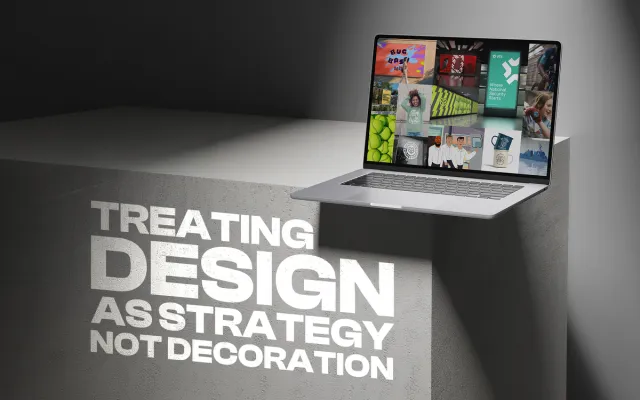
Most companies don’t decide to treat design as decoration. It happens by default. The product is built, the strategy is set, the budget is mostly spent, and then someone asks, “Can we make it look good?”
That question is where the money leaks out.
Design is the part of your business that customers actually touch. They never see your strategy deck. They see your website, your packaging, your proposal, your logo on a truck. When design arrives at the end of the process, it can only polish decisions that have already been made. When it arrives at the start, it shapes them.
This is the case for moving design upstream, and for judging it by what it does for the business rather than how it looks.
What “design as decoration” actually costs
The decorative model usually shows up in three ways.
The rebrand that changes nothing. A new logo and a refreshed palette go live, and the sales conversation stays exactly the same. The visuals changed, but nobody asked what the brand needed to say or whom it needed to win.
The website that looks great and converts poorly. It was designed to impress internal stakeholders instead of guiding a buyer from curiosity to inquiry. Pretty and persuasive are different briefs.
The campaign that fights the brand. Marketing creates assets under deadline, and each one drifts a little further from the last. Over a year, the brand looks like six different companies.
None of these are design failures in the craft sense. They are strategy failures that surface through design, because no one treated design as the place where strategy becomes visible.
What the research says (and what it doesn’t)
The most cited evidence comes from McKinsey’s study of 300 publicly listed companies. Over a five-year period, companies in the top quartile of the McKinsey Design Index grew revenue 32 percentage points more, and shareholder returns 56 percentage points more, than their industry peers. You can read the full findings in McKinsey’s “The Business Value of Design”. mckinsey
Two details in the report matter more than the headline.
First, this is correlation, not a guarantee. Strong companies may simply be better at many things, design included. Anyone promising that a new logo will lift revenue by a fixed percentage is selling something.
Second, the advantage wasn’t spread evenly. McKinsey found the gap between the second, third, and fourth quartiles was small, and the real payoff went to the companies at the top. Being “fine” at design earns you very little. The reward goes to companies that take it seriously enough to be distinctive.
The practices McKinsey linked to those results weren’t about aesthetics. They were analytical leadership, cross-functional talent, continuous iteration, and user experience. In other words, top performers measure design, build it into decisions, keep improving it, and design around real users. That is a strategy posture, not a styling one.
Five places design does strategic work
1. Positioning
A brand identity is a positioning argument made visible. Typography, color, tone, and imagery tell a buyer in seconds whether you’re the premium option, the practical one, or the newcomer worth watching. If your visual identity doesn’t match your market position, buyers feel the gap even when they can’t name it.
That is the thinking behind our design and branding work: the identity should do a job, not just exist.
2. Trust
People judge credibility fast and rarely admit how much of it comes from appearance. For firms selling services, expertise, or anything with a long sales cycle, design is the first proof of competence a prospect sees. Inconsistent or dated materials raise a quiet question: if they’re careless here, where else?
3. Conversion
A website is a sales asset. Information architecture, page hierarchy, load speed, and calls to action all determine whether visitors become leads. Effective web design and development starts with how a buyer decides, then builds the interface around that path.
4. Marketing efficiency
A coherent identity makes every marketing dollar work harder. Recognition compounds when ads, social posts, emails, and landing pages feel like they come from the same place. Without that system, you pay to re-introduce yourself every time. This is why strong digital marketing starts with strong brand foundations rather than the other way around.
5. Internal alignment
A clear brand gives your team something to build against. Sales, hiring, product, and communications all make better decisions when they share a point of view about who the company is. Design systems and brand guidelines are operational tools as much as creative ones.
A quick test: is design strategic at your company?
Ask these honestly:
- Does design get a seat in planning conversations, or does it receive finished briefs?
- Can your team explain in one sentence what your visual identity is meant to communicate?
- Do you measure anything about your design’s performance, such as conversion rates, time on page, or brand recall?
- Would a stranger recognize your materials across channels without seeing the logo?
- Do you revisit and improve design continuously, or only when something feels old?
If most answers are “no,” design is probably still decoration in your organization. That’s common, and it’s fixable.
Making the shift: what to do first
Start with the business problem, not the deliverable. “We need a new website” is a request. “We’re losing qualified leads between the homepage and the contact form” is a brief. Good agencies push you toward the second.
Audit for consistency before spending on novelty. Many brands are one disciplined guidelines document away from looking dramatically more credible.
Define success before the work begins. Pick two or three metrics tied to revenue, leads, or retention, and review them after launch.
Plan for iteration. Design that earns its keep is maintained, tested, and refined. For teams that need steady creative output without a full-time hire, a design retainer can keep quality and consistency high while spreading cost across the year.
Choose partners who think in systems. The most useful creative partner can move between brand, web, motion, and campaign work without losing the thread. That integration is what makes a strategy visible across every touchpoint.
Why this matters for Washington, DC-area organizations
The DC region is a dense, credential-heavy market. Government contractors, associations, nonprofits, professional services firms, and growing local businesses all compete for attention from audiences who evaluate vendors carefully and compare them constantly. In a market that crowded, looking competent is the minimum. Being distinct and clear is what gets you shortlisted.
That’s the market a Washington DC creative agency works in every day, and why we treat identity, web, motion, and marketing as one connected system rather than separate line items. You can see how that plays out across branding, web, and animation projects in our portfolio, including work like UT Services and WILLIS.
Frequently asked questions
What does it mean to treat design as strategy?
It means involving design in decisions about positioning, audience, and customer experience from the start, and measuring it against business outcomes rather than approving it on taste alone.
Is investing in branding worth it for a small or mid-sized business?
Often it’s worth more, because smaller organizations have fewer resources to spend explaining who they are. A clear identity does that work automatically, in every interaction.
How do I measure the ROI of design?
Tie it to specific outcomes: website conversion rate, lead quality, sales cycle length, brand search volume, repeat business, or marketing cost per acquisition. Set a baseline before work starts and compare afterward.
How do branding, web development, and digital marketing fit together?
Branding defines what you stand for, your website turns that into a buying experience, and digital marketing brings the right people to it. When they’re built together, each one performs better.
The bottom line
Decoration asks, “Does this look good?” Strategy asks, “Does this make the business stronger?” The best design answers both, but only the second question earns a place in the budget.
If your brand looks like it’s still waiting for its strategy to catch up, let’s talk. Contact Design Noon to discuss where design can do more for your business.